
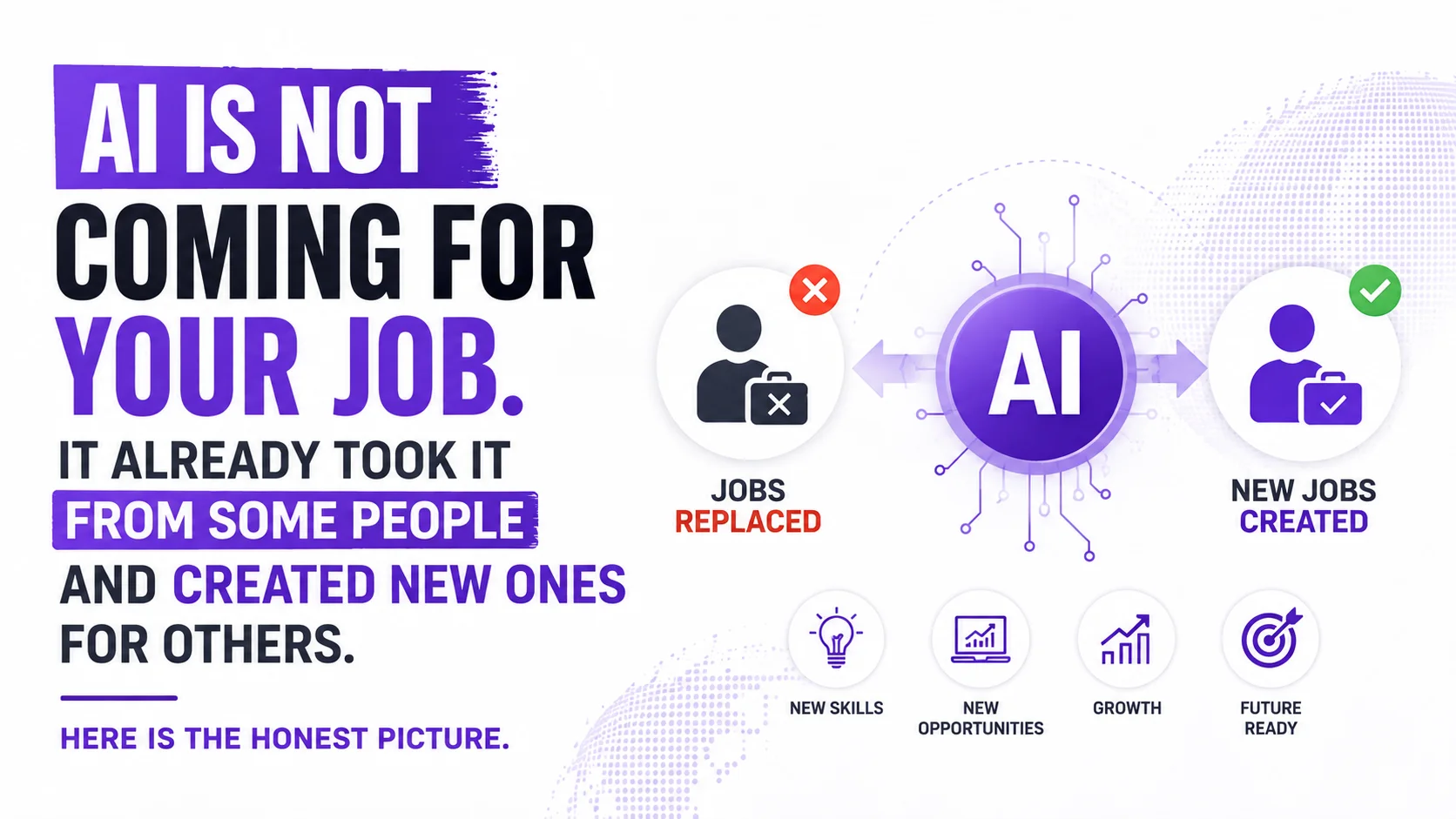
Let us start with the number that nobody in the IT industry wants to say out loud.
India’s IT sector lost over 50,000 jobs in 2024 primarily among entry-level programmers and software testers. TCS, the country’s largest IT exporter, shed more than 23,400 positions in a single financial year. Ola Electric automated its front-end operations and let go of 1,000 employees. Globally, more than 177,000 tech workers were laid off in 2025 roughly 586 every single day.
These are not rumours from LinkedIn feeds. These are documented facts from government think-tanks, industry research firms, and corporate disclosures.
Now for the part that the panic-headlines leave out.
India had 2.9 lakh AI-based jobs in 2025 — and that number is projected to grow by 32% in 2026. Agentic AI is expected to redefine 10.35 million roles by 2030, according to a ServiceNow and Pearson research report released in July 2025. The World Economic Forum projects that AI will generate 12 million more jobs than it displaces. NITI Aayog says that if India skills its workforce strategically, the IT sector could add four million jobs in the next five years — not lose them.
So what is actually happening? And more importantly — what should you do about it?
At Aryu Technologies in Chennai, we work at the intersection of AI, DevOps, cloud, and automation every day — building the kinds of systems that are both changing the workforce and creating new opportunity within it. This is our honest, data-grounded read on what is happening and what it means for Indian IT professionals right now.
What Is Actually Happening to IT Jobs in India?
AI is not replacing IT jobs in India the way most people fear — as a sudden mass deletion of entire professions. What is happening is a structural shift: AI is automating specific tasks within roles, which means companies need fewer people for routine work, while dramatically increasing demand for people who can build, manage, and think alongside AI systems.
TeamLease Digital, a talent solutions firm serving India’s IT industry, described the current wave of job losses as a “structural — not cyclical — correction driven by AI-led productivity compression.” That distinction matters. A cyclical correction reverses when the economy picks up. A structural correction does not — it represents a permanent change in how work is organised and what skills are needed.
The roles most directly affected are ones built around predictable, repetitive execution: manual software testing, L1 tech support, basic data entry, routine coding tasks, and lower-level documentation. These are not disappearing instantly — but companies are hiring far fewer people for them than they did two years ago, and that trend will continue.
What companies are hiring aggressively for instead is telling: cloud engineers, DevOps specialists, AI/ML developers, cybersecurity professionals, data engineers, and automation architects. These are the roles that manage the intelligent systems — not the roles that get replaced by them.
The IT Roles That Are Shrinking — And Why
Being clear-eyed about this matters. Pretending these changes are not happening does not protect anyone — it just delays the moment when professionals have to confront a market that has moved on without them.
Manual Software Testing
AI-powered testing tools can now run thousands of test cases in minutes, detect regressions automatically, and generate test scripts from natural language descriptions. The volume of manual test execution work that used to require large teams has collapsed. Testers who only know how to execute test cases are finding their market significantly narrowed. Testers who know how to design, architect, and oversee automated testing systems are in high demand.
Level 1 (L1) Tech Support
Large Language Models and AI chatbots have made a serious dent in the volume of work that used to flow to L1 support agents. Routine password resets, FAQ responses, ticket routing, and basic troubleshooting are increasingly handled by AI assistants that do not take breaks and do not require salaries. Companies are maintaining L2 and L3 support teams — but L1 headcount is being systematically reduced.
Routine Coding and Junior Development
GitHub Copilot, Cursor, Claude, and other AI coding assistants can now produce functional code from natural language descriptions, complete repetitive code blocks, catch bugs, and suggest refactors in real time. A senior developer with AI tools can do the output volume of two or three junior developers working without them. This does not mean junior developers are finished — but it does mean that freshers who cannot demonstrate more than the ability to write basic code are struggling to find their footing in a market that has fundamentally changed its expectations.
Data Entry and Basic Data Processing
RPA (Robotic Process Automation) and AI-powered data pipelines have automated most of what used to be manual data entry and processing work. This was already underway before the current AI wave — but the pace has accelerated significantly. Any role whose primary responsibility is moving data from one place to another in a structured way is at direct risk.
The IT Roles That Are Growing Fast — Right Now
Here is what the same data shows on the other side of the ledger — the roles that are expanding as the roles above contract.
- DevOps and Platform Engineering: Every AI system needs infrastructure. Every cloud migration needs DevOps. Every automated pipeline needs someone who built and maintains it. DevOps engineers are the architects of the systems that AI runs on — which is precisely why they are not being displaced by AI. They are being hired to deploy it.
- AI/ML Engineering: India had 2.9 lakh AI-based jobs in 2025 — and they cannot be filled fast enough. AI engineers who can build, fine-tune, deploy, and maintain machine learning models are commanding salaries that would have been considered exceptional even for senior software engineers three years ago.
- Cloud Architecture: India’s enterprise cloud migration is not slowing down. Every business moving its infrastructure to AWS, Azure, or GCP needs cloud architects, engineers, and administrators who can design, manage, and secure what they have built. This demand is structural and long-term.
- Cybersecurity: As AI gets embedded into more systems, the attack surface expands. Cybersecurity professionals who can protect AI-integrated infrastructure are among the most in-demand specialists in the entire IT market. DevSecOps engineers — who build security directly into development pipelines — are particularly sought after.
- RPA and Intelligent Automation: Somewhat paradoxically, the very category of automation that is eliminating routine work is creating strong demand for professionals who can design, implement, and manage those automation systems. RPA architects and automation engineers are not being replaced — they are being hired to replace manual processes.
- Data Engineering and Analytics: AI runs on data. Every organisation building or deploying AI needs data engineers who can design pipelines, maintain data quality, and build the infrastructure that feeds the models. Data engineering is one of the fastest-growing specialisations in Indian IT.
The Real Question Is Not ‘Will AI Take My Job?’ — It Is ‘Am I Building the Right Skills?’
The professionals who are thriving in this environment share a specific quality: they have stopped thinking of themselves as executors of defined tasks and started thinking of themselves as designers and managers of systems.
That shift is not as dramatic as it sounds. It does not require becoming an AI researcher or a machine learning engineer. It means understanding enough about the tools that are automating your industry to work with them intelligently rather than being displaced by them.
A software developer who understands how to use AI coding tools, version control, and CI/CD pipelines to ship faster is more valuable than before — not less. A tester who designs automated test frameworks rather than running manual cases is irreplaceable. A support professional who can configure, manage, and improve an AI support system is doing higher-value work than the L1 role that AI is absorbing.
The pattern is consistent across every role category: professionals who move up the value chain — from execution to design, from operating systems to building them — are finding more opportunity, not less. The ones who stay at the execution level of tasks that AI can replicate are the ones experiencing displacement.
What Businesses Need to Understand Right Now
The AI disruption conversation is almost always framed around individual workers. But the business-level decisions being made right now are equally consequential — and businesses that approach this moment without a clear strategy are setting themselves up for serious competitive disadvantage.
- Automation without strategy is waste. Companies that automate in a disorganised way — bolting AI tools onto broken processes — do not get the efficiency gains they expect. Effective automation requires a clear assessment of which workflows are actually suitable for automation, proper implementation, and ongoing management. Done right, RPA and AI automation can cut operational costs by 30 to 50% on targeted processes. Done carelessly, it creates new problems faster than it solves old ones.
- Cloud migration is not optional anymore. Businesses still running on-premise infrastructure are increasingly unable to take advantage of the AI tools that are available only as cloud-native services. The gap between cloud-first and on-premise businesses is widening — in capability, speed, and cost structure.
- Custom software beats generic platforms for complex operations. Off-the-shelf SaaS tools work for standard workflows. But businesses with complex, industry-specific operations — fintech, healthcare, manufacturing, logistics — consistently find that custom software built around their actual processes outperforms generic solutions at scale. The investment pays back faster than most business leaders expect.
- Security cannot be an afterthought in an AI-integrated stack. Every new integration point is a potential vulnerability. As businesses add AI tools, automate workflows, and move to the cloud, cybersecurity needs to be built into the architecture — not applied as a layer after the fact. DevSecOps is not a luxury; it is the minimum viable approach for any business serious about data protection.
How Aryu Technologies Helps Businesses Navigate This Shift
Aryu Technologies was founded on a straightforward premise: businesses should not have to figure out the technology landscape alone. The speed at which AI, cloud, and automation are evolving creates genuine complexity — and making the wrong architectural decisions early is expensive to undo.
Our team in Chennai works across the full stack of modern IT services — and every service we offer is specifically relevant to the moment businesses are navigating right now:
- DevOps Services: We design and implement CI/CD pipelines, container orchestration, and infrastructure automation that allows software teams to ship faster, more reliably, and with fewer manual bottlenecks. DevOps is the operational backbone that makes everything else scale.
- RPA and Intelligent Automation: We identify the specific workflows in your business where automation delivers the highest ROI, build the automation systems to handle them, and manage the implementation so your team can focus on higher-value work.
- AI and Machine Learning Solutions: From predictive analytics and intelligent data processing to AI-powered product features, we help businesses move from curiosity about AI to actual deployment — with proper infrastructure, governance, and measurable outcomes.
- Cloud Services: Cloud migration strategy, infrastructure design, cost optimisation, and ongoing cloud management — including the security architecture that keeps cloud environments compliant and protected.
- Custom Software Development: Tailored applications for fintech, e-commerce, enterprise operations, and CRM/ERP — built to fit actual workflows, not retrofitted templates.
- Blockchain and Emerging Tech: For businesses exploring decentralised solutions, smart contracts, and supply chain verification — we build practical implementations, not proof-of-concept experiments that go nowhere.
5 Things IT Professionals Should Do Right Now — Not Eventually
This section is for the IT professionals reading this who are trying to decide whether to take this seriously or not. Take it seriously. Here is what actually moves the needle.
- Audit your skills against the market right now. Open five job descriptions for roles one level above yours on Naukri or LinkedIn. Look at what they are asking for. If the gap between what they require and what you currently know is significant, that is your roadmap — not a cause for panic.
- Learn one cloud platform properly — not superficially. Pick AWS, Azure, or GCP based on what your target employers use. Get the foundational certification. Then get the associate or professional level. Cloud knowledge is the single most transferable skill in the current market — it opens doors across DevOps, data engineering, cybersecurity, and AI roles simultaneously.
- Start using AI tools in your actual work today. Professionals who understand how AI coding tools, AI analytics platforms, and AI automation systems work in practice are significantly more valuable than those who understand them only theoretically. You learn this by using them — not by reading about them.
- Build something that demonstrates your current skills. A GitHub profile with real projects, a deployed application, a documented automation pipeline — anything that a hiring manager can look at and immediately understand what you are capable of. In 2026, your GitHub profile matters more than your resume. Your resume gets you noticed. Your projects get you hired.
- Move faster than you think you need to. Every professional who has been through a major technological shift in their career says the same thing: they wish they had started adapting earlier. The window between “this is coming” and “this is already here” closed faster than anyone expected. It is closing again.
Conclusion
AI is not coming for all IT jobs. It has already restructured some of them permanently and is in the process of restructuring more. That is the uncomfortable truth. But the data also shows, clearly and consistently, that the number of high-value IT roles being created is large — larger than what is being eliminated, if you look at the full picture rather than just the layoff headlines.
The professionals who thrive in the next five years will not be the ones who worried about AI the most. They will be the ones who understood it earliest, upskilled the fastest, and positioned themselves on the building side of the shift rather than the displaced side.
And the businesses that come out ahead will be the ones that moved deliberately — not reactively — to integrate the right technology, with the right partners, at the right pace.
If you are a business trying to figure out where to start, or an IT professional who wants to talk through your next move Aryu Technologies is right here in Chennai. Let us have that conversation. Visit aryutechnologies.com or reach us at info@aryutechnologies.com