
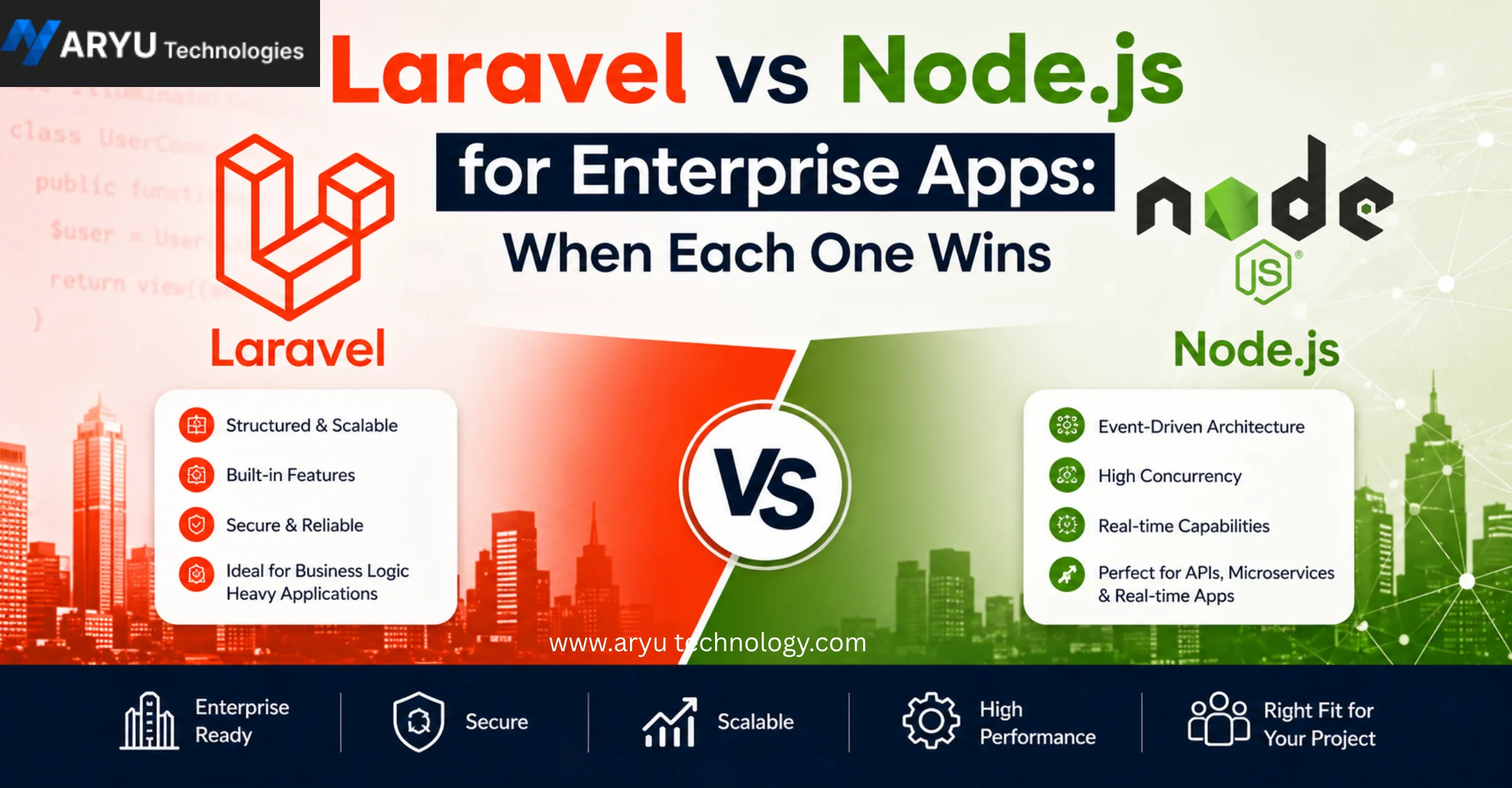
Choosing the right technology for an enterprise application is not just a matter of picking the most popular framework. Enterprise apps need to handle security, scalability, performance, integrations, maintenance, and long-term business growth. Two technologies that often come up in this conversation are **Laravel and Node.js**. Both are powerful, but they take very different approaches to application development. So, **Laravel vs Node.js — which one is better for enterprise applications?**
What Is Laravel?
Laravel is a popular PHP web framework designed to make application development cleaner, faster, and more organized. It follows the **Model-View-Controller (MVC)** architecture and provides many features out of the box, including routing, authentication, database migrations, queues, caching, validation, and task scheduling. Laravel is particularly useful for businesses that need secure and structured web applications without building every component from scratch.
Why Enterprises Choose Laravel
* Clean and organized MVC architecture
* Built-in authentication and authorization features
* Powerful database tools through Eloquent ORM
* Easy API development
* Queue and job processing
* Built-in caching support
* Strong security features
* Excellent testing support
* Large PHP ecosystem
* Easier development and maintenance
What Is Node.js?
Node.js is a JavaScript runtime that allows developers to run JavaScript outside the browser. Unlike traditional server-side architectures that often use a separate language for frontend and backend development, Node.js makes it possible to use JavaScript across the entire application stack.
Node.js uses an **event-driven, non-blocking architecture**, making it particularly suitable for applications that handle many simultaneous connections.
Why Enterprises Choose Node.js
Node.js is a strong choice for applications that require:
* Real-time communication
* High concurrency
* Fast API responses
* Microservices
* WebSockets
* Streaming applications
* Event-driven systems
* Scalable backend services
* JavaScript-based full-stack development
When Laravel Wins for Enterprise Apps
Laravel is often the better choice when your enterprise application needs a **structured development environment and a wide range of built-in business features**.
1. Large Business Management Systems
Applications such as ERP systems, CRM platforms, HR management systems, accounting applications, and inventory management systems often benefit from Laravel. These applications typically contain complex business rules, user roles, reports, forms, workflows, and database relationships.
2. Applications With Complex Database Operations
Laravel’s Eloquent ORM makes working with relational databases much easier.
Developers can work with database relationships and queries using expressive PHP syntax instead of writing SQL for every operation.
3. Faster Development
Laravel provides many features developers commonly need. Authentication, validation, routing, queues, migrations, caching, and other tools are readily available. This means development teams can focus more on business functionality rather than repeatedly building basic infrastructure.
4. Security-Focused Applications
Enterprise applications often deal with sensitive business information. Laravel provides built-in mechanisms and conventions that help developers implement features such as authentication, authorization, password hashing, CSRF protection, and input validation.
5. Long-Term Maintainability
Enterprise applications can live for many years. Laravel’s structured architecture can make large codebases easier for teams to understand, test, and maintain.
1. Real-Time Applications
If your application depends on information being updated instantly, Node.js is a strong candidate.
Examples include:
* Chat applications
* Live dashboards
* Collaboration platforms
* Online gaming systems
* Real-time notifications
* Trading platforms
* Delivery tracking applications
2. High-Concurrency Applications
Node.js can efficiently handle many I/O operations without blocking the main execution flow. This makes it useful for applications where the server receives a large number of simultaneous requests involving network or database operations.
3. Microservices Architecture
Modern enterprise systems are increasingly moving toward microservices. Node.js is well suited to building small, independently deployable services. Different services can be developed, scaled, and deployed separately, allowing organizations to evolve large systems without treating the entire application as one codebase.
4. JavaScript Across the Stack
Organizations with strong JavaScript teams may prefer Node.js because developers can use JavaScript or TypeScript across frontend and backend development. This can simplify hiring, knowledge sharing, and development workflows.
5. APIs and Lightweight Services
Node.js is particularly effective for building REST APIs, backend-for-frontend services, and lightweight application services.
* Load balancing
* Database optimization
* Caching
* Queues
* Redis
* Horizontal server scaling
* CDN integration
Laravel vs Node.js: Which Is More Secure?
Security isn’t determined simply by choosing Laravel or Node.js. Both can be used to build secure enterprise applications when developers follow appropriate security practices. Laravel provides many security-related features and conventions within the framework. With Node.js, developers have access to a large ecosystem of security libraries and tools, but they need to carefully manage dependencies and application configuration.
* Secure authentication
* Role-based access control
* Input validation
* Encryption
* Secure API design
* Dependency updates
* Logging and monitoring
* Security testing
* Database security
* Secure server configuration
Laravel vs Node.js: Development Cost
Development cost depends on more than the framework. Factors such as project complexity, developer availability, integrations, features, infrastructure, testing, and maintenance all affect the total cost. Laravel can sometimes reduce development time because many common backend features are built into the framework. Node.js can also be highly cost-effective, particularly when an organization already has JavaScript or TypeScript expertise.
Laravel vs Node.js: Performance
Performance depends heavily on application architecture and implementation. Node.js has an advantage for workloads involving many concurrent I/O operations, particularly real-time applications and APIs. Laravel can deliver excellent performance for business applications when developers use appropriate caching, database optimization, queues, efficient queries, and scalable infrastructure.
* You’re building an ERP, CRM, or business management platform
* Your application has complex database relationships
* You need rapid backend development
* Your team has strong PHP experience
* You want a structured MVC framework
* Built-in businessfeatures are important
* Long-term maintainability is a major priority
Choose Node.js if:
* You’re building a real-time application
* You expect high levels of concurrent traffic
* WebSockets are important
* You need lightweight, scalable APIs
* Your team is experienced in JavaScript or TypeScript
* Event-driven architecture fits your application
Can Laravel and Node.js Work Together?
Yes. Enterprises don’t always have to choose one technology for everything. A hybrid architecture can use Laravel for the core business application while Node.js handles specific real-time or high-concurrency services.
For example:
Laravel:
Handles authentication, business logic, administration, database-heavy operations, and enterprise workflows.
Node.js:
Handles real-time notifications, WebSocket communication, live dashboards, or specific API services.
Final Verdict: Laravel vs Node.js for Enterprise Applications
There isn’t a universal winner in the **Laravel vs Node.js** debate. Laravel is an excellent choice for structured, database-driven enterprise applications where development speed, maintainability, and built-in functionality matter. Node.js shines when real-time communication, high concurrency, APIs, and distributed architectures are at the center of the project. The best choice ultimately depends on your application’s requirements rather than technology trends.
Choose Laravel when you need a mature, structured framework for complex business applications. Choose Node.js when you need an event-driven platform built for real-time and highly concurrent workloads.
Conclusion
Choosing a backend technology is a long-term business decision. The right platform should support your current requirements while giving your application room to grow. Laravel and Node.js are both capable of powering enterprise-grade applications, and the best choice depends on your application’s specific requirements, architecture, scalability needs, and development goals.
If you are evaluating Laravel, Node.js, or a combination of both for your next enterprise application, ARYU Technology can help you choose the right technology stack and build a scalable, secure, and maintainable solution. From business applications and APIs to real-time systems and custom software development, choosing the right architecture from the beginning can make a significant difference to long-term performance and growth.
Ultimately, don’t choose a technology simply because it is popular. Choose the one that fits your business requirements and future goals.
Frequently Asked Questions
1. Is Laravel or Node.js better for enterprise applications?
Neither is universally better. Laravel is excellent for structured, database-driven business applications, while Node.js is particularly strong for real-time, highly concurrent, and distributed applications.
2. Is Node.js faster than Laravel?
Node.js can have an advantage for I/O-heavy and highly concurrent workloads. However, real-world application performance depends on architecture, database queries, caching, infrastructure, and code quality.
3. Is Laravel good for large-scale applications?
Yes. Laravel can power large enterprise applications when supported by proper architecture, caching, database optimization, queues, monitoring, and scalable infrastructure.
4. Is Node.js suitable for enterprise applications?
Yes. Node.js is widely suited to enterprise APIs, microservices, real-time systems, streaming applications, and high-concurrency platforms.
5. Which is easier to develop with, Laravel or Node.js?
Both can provide fast development. Laravel offers many built-in backend features, while Node.js provides flexibility and a large JavaScript ecosystem. The easier option often depends on your development team’s existing skills.